Vetting
Vetting is essential and obligatory for all persons with access to children and vulnerable adults and those making decisions regarding the welfare of children at local, regional and national level.
The NCFFI has a specific responsibility under the National Vetting Bureau (Children and Vulnerable Persons) Acts 2012 to 2016 which provides a statutory basis for the vetting of persons carrying out relevant work with children or vulnerable persons.
The Act stipulates that a relevant organisation shall not permit any person to undertake relevant work or activities on behalf of the organisation, unless the organisation receives a vetting disclosure from the National Vetting Bureau in respect of that person. A person who contravenes this shall be guilty of an offence.
In accordance with the NCFFI Safeguarding Policy it is a requirement for all clubs to have a Children’s Officer in place with in-date vetting along with all NCFFI Coaches.
GARDA VETTING
The NCFFI Executive has appointed Der Casey the Contact Person for the NCFI in respect of Garda Vetting, with approval from the Federation of Irish Sport who will process the applications directly with the NVB.
Legislation relating to Vetting in ROI
The National Vetting Bureau (Children and Vulnerable Persons) Act 2012 to 2016, together with the Criminal Justice (Spent Conviction and Certain Disclosures) Act 2016 part 3 provide the legislative basis for persons working in relevant work or activity to undergo a vetting check prior to working with children or vulnerable persons. In addition, the following legislation is also considered:
• Civil Service Commissioners Act 1956
• Child Care Act 1991 – Sections 5; 61; 65
• Data Protection Act 1988/2003
• Children’s Act 2001 – Section 258 • Private Security Authority Act 2004
Exemptions under the legislation in ROI
Within the National Vetting Bureau Act certain exemptions from vetting are outlined in Sect. 3 (1) (c): Sect 3 (1) (c) states, persons giving of assistance on an occasional basis (i.e. at training sessions, competitions, national squad etc.) and for no commercial consideration at an event would not be required to be vetted.
Who is required to be vetted?
The National Coarse Fishing Federation of Ireland, NCFFI is responsible for ensuring members and individuals operating at national level are vetted in accordance with this policy.
All persons in a role that provides an opportunity for unsupervised access to children must undergo the vetting process. These positions are referred to as undertaking relevant work or activity (NVB) defined in the National Vetting Bureau (Children and Vulnerable Adults) Act 2012 to 2016.
It is additionally our policy that all those representing the NCFFI on International Duty are vetted.
Individuals who must be vetted are those applying for positions including but not limited to the following:
• Children’s Officer/ Designated Liaison Person
• Coach
• Instructor
• Tutor
• Youth Team Manager /Chaperone
• Official (competition organiser, weigh person, steward, fishery monitor, water-keeper)
• Driver
• Club committee member/officer *
* Unless the positions highlighted are responsible for one of the roles below on a regular basis then they would not be required to undergo a vetting or disclosure check.
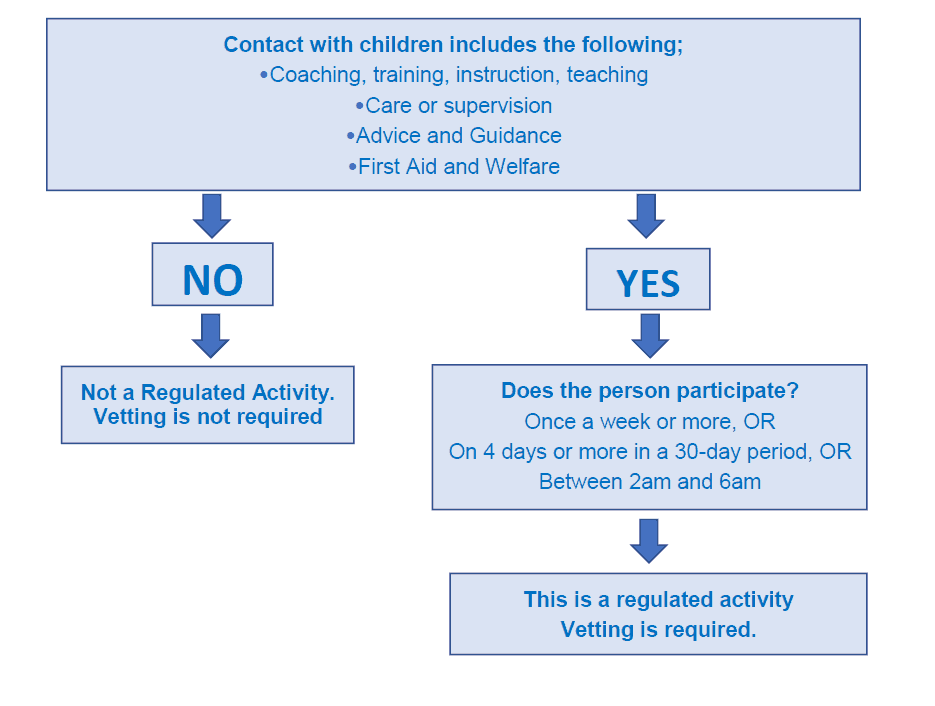
A Vetting or Disclosure check will be required where an individual undertakes relevant work or activities relating to children or vulnerable adults, where such involvement includes:
• Coaching, Mentoring
• Teaching, training or instruction
• Care or supervision, including health care and relevant personal care
• Advice or guidance provided wholly or mainly for children relating to their physical, emotional or educational well-being
• Moderating a public electronic interactive communication service likely to be used wholly or mainly by children
• Driving a vehicle being used only for conveying children and carers or supervisors.
Day to day management or supervision on a regular basis of a person carrying out one of these activities is a regulated activity.
Activities that are excluded from the definition of a regulated activity are;
• family arrangements and personal, non-commercial arrangements e.g. looking after a friend’s child unpaid.
• a person within a group assisting another member of the group (termed ‘peer exemption’)
• incidental contact – the presence of children is unforeseen, and the activity is not being provided to children
Regularly is defined as: carried out by the same person frequently (once a week or more often), or on 4 or more days in a 30-day period, or overnight. In relation to training or instruction, care or supervision, advice or guidance, it is also a regulated activity if carried out (even once) at any time between 2am and 6am and with the opportunity of face to face contact with children.
Definition of Occasional Work
An individual not previously vetted can carry out an occasional role on the following basis:
• The individual must be known to the club/affiliate/manager
• The occasional role involving our young members/vulnerable adults can only be carried out one or less times per month at any level. I.e. once at club level and once at affiliate level in any one calendar month exceeds the definitions of Occasional Work.
• The person carrying out the Occasional Work must always be supervised by a vetted person
• The person must sign a Code of Conduct relevant to the level of the organisation
Toggle Title
Toggle Content goes here
Vetting of Minors
If a person under the age of 18 is identified as one requiring vetting, the applicant will also need to complete a Parental Consent Form (NVB 3) which must be submitted along with the e-vetting Invitation and ID Verification Form to allow the vetting to proceed. Vetting is not permitted for those aged under 16.
Vetting Charges
The National Coarse Fishing Federation of Ireland will fund the €10 processing fee for its members in order to support juniors on the bank. We reserve the right to pass on this fee to the applications at a future date should the need arise.
Verification of Identify
On the commencement of the National Vetting Bureau Act, the NVB introduced the requirement of an ID Check for each person seeking vetting through them. The NCFFI asks the Club’s officers to facilitate this process. Identification verification of a person applying for vetting will be required at club level before the applicant can access the vetting form and submit it to the NCFFI for processing.
Re-Vetting
The NCFFI recommends that individuals undergo re-vetting after the three-year period, this may be subject to change in line with legislation. Existing applicants may be re-vetted if information concerning an individual’s suitability to work with children comes to the attention of an Affiliate Club or the NCFFI.
Data Protection
The NCFFI complies with best practice regarding the secure storage, handling and use of the Vetting Bureau disclosures and personal vetting information, all information pertaining to the vetting process will be held in a manner consistent with our Privacy Policy
ACCESS NI
Coarse Angling Development Officer, Barry Scott is the lead contact for the NCFFI in respect of ACCESS NI, with approval from the Northern Ireland Sports Forum who will process the applications directly with ACCESSNI.
You can apply for the Enhanced Disclosure for your club officers and volunteers by following the link below and first creating a NIDirect account.
www.nidirect.gov.uk/services/apply-online-enhanced-check-through-registered-body
When you create your NIDirect account, you’ll receive a confirmation email immediately. Once you activate your account you can log in and apply for an enhanced check.
You’ll need:
The pin number: 596155, your address(es) for the last five years, your National Insurance number.
You will be required to upload identification in accordance with the list of accepted documents.
There are two parts to the ACCESS NI application. Once you have received your online reference number you must inform us of the application number here to complete the process.
